Knowing where you are is one of the key bits of information needed to keep yourself safe on the hills, particularly in winter.
In the right context, with the right progression, nav can be a fun activity. Or it can be something that fills you with dread.
These tips will help make the winter element of nav easier to manage. Ultimately you need to be confident navigating in summer conditions before you’re going to feel comfortable with winter navigation.
If you’re not confident navigating in summer then consider doing a course to speed up your learning.
1) Map scale
Features, like streams, disappear under snow so we can’t rely on them for navigating in winter. Therefore in winter it’s typical to use small scale maps as we don’t want the clutter of a feature heavy map.
I love using the Harveys 1:40,000. I find it a great compromise between feature set and scale. Alternatively I’ll use the OS 1:50,000. I avoid a 1:25,000 map.
2) Use a decent compass
Worth investing in a decent compass, the more you spend the more reliable they become.
I love the Silva Spike Jet Zoom. (Warning; it doesn’t have a 1:50,000 scale measure on it so you might have to do some maths if you’re not using a Harveys 1:40,000 map).
3) Use your compass to clean
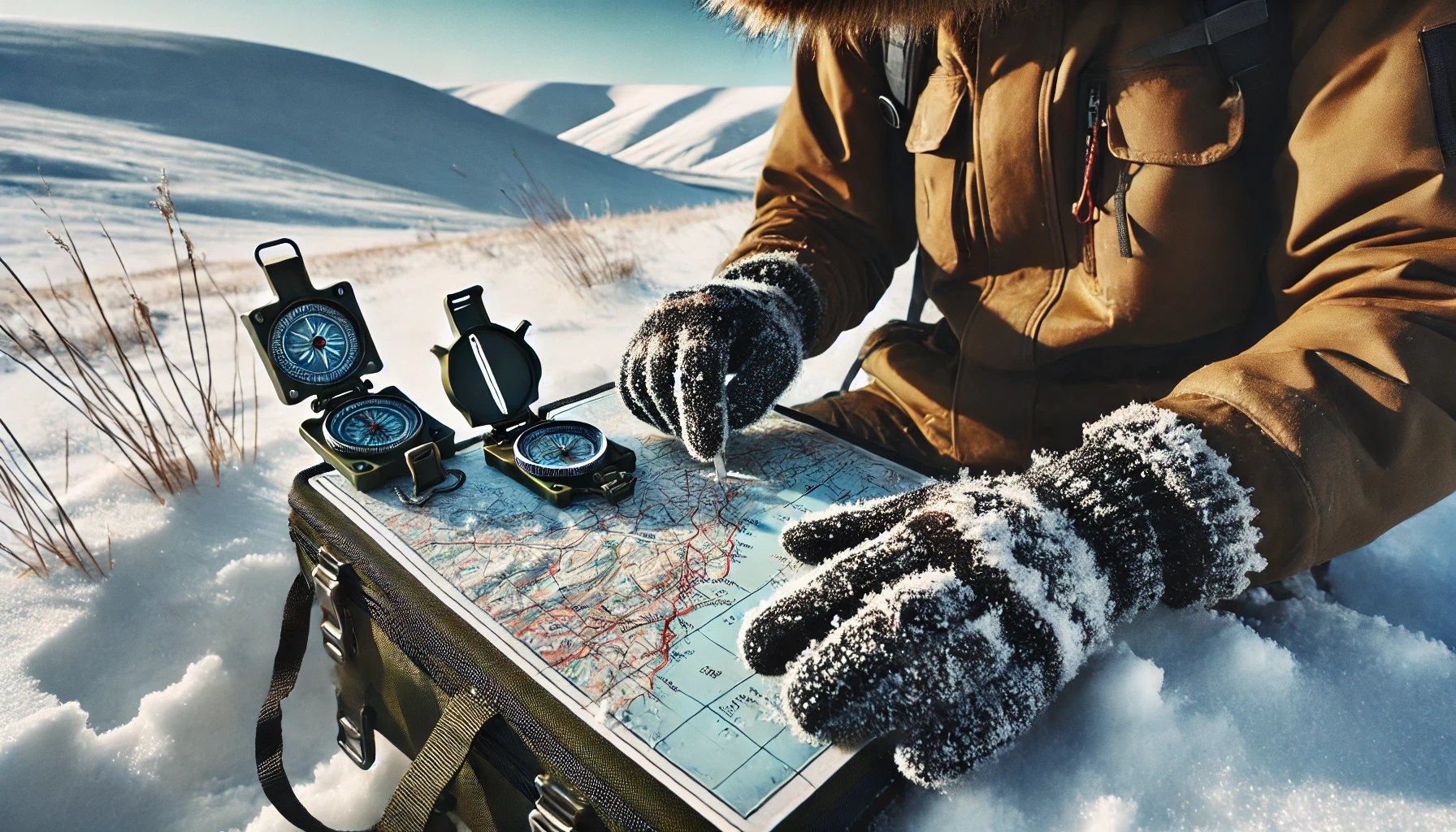
Maps rime up, becoming unreadable thanks to ice forming on them. Use your compass edge to occasionally scrape away any build up to avoid ice becoming an issue.
4) Practice in large gloves
Operating a compass can be really tricky wearing think gloves or mittens. Practice navigating wearing your winter gloves in circumstances which are forgiving. With practice you can become quite dexterous, even in thick gloves.
5) Don’t lose your map & compass
I’ve been stood on a wintery, windy hillside in the Lakes and witnessed two people in quick succession pull their maps out and watch them fly into the distance, never to be seen again.
Oops.
You can avoid this classic mistake by keeping your map in a case (also makes it waterproof and less flimsy when taking bearings) and using a cord to tether it to your bag or clothing.
I’ve found an A5 Ortlieb map case to be the best option and I like using a thin, strong nylon cord tied onto a DMM XSRE or the equivalent so I can easily change where I store the map (jacket pocket, bag strap etc.).
I do the same for my compass.
 WinterSkills.Scot