Why Do I Need an Axe?
A mountain axe offers runners three key benefits:
- Stability: It aids in maintaining balance on challenging terrain.
- Emergency Protection: In the event of a slip, the axe is essential for self-belay or self-arrest, preventing a slide from becoming fatal.
- Credibility: Carrying an axe makes you look cool.
In the event of a slip, knowing how to use your axe correctly could save your life.
Knowing how to stop an unintended slide is a critical winter mountain skill.
Carrying an axe isn’t enough—you must practice and master the techniques needed for an emergency.
Learning and honing these skills in a safe environment, guided by someone experienced, is wise.
Choosing the right axe
“Can I just use a walking/mountaineering axe I already own?”
Yes.
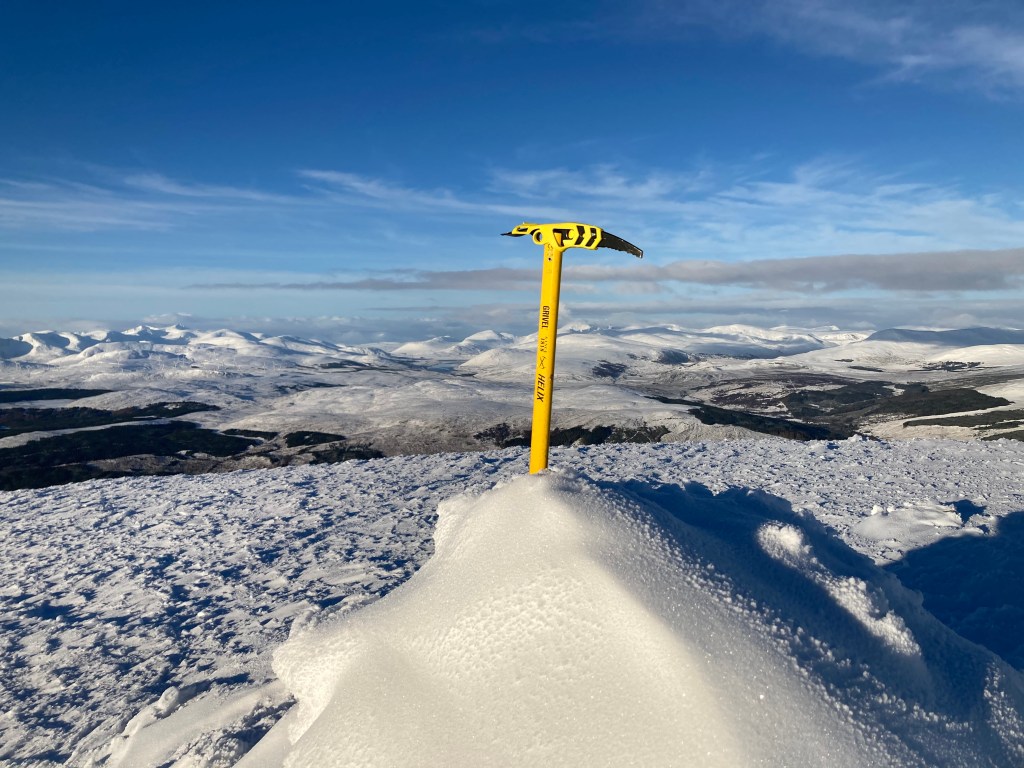
For runners, a traditional straight-handled walking/mountaineering axe will do the job in the event of a slip. This style of axe can help make some of the safety skills slightly easier to learn. However they are not light and are not ideal for any tricky steep ground work.
If I were getting my first axe with hill running in mind I’d get something slightly different…
Types of Axes
- Walking/Glacial Axe: Typically featuring a straight shaft, this traditional axe is heavier, designed for cutting ice steps—a method used before crampons became common.
- Ice Climbing Axe: Built for technical climbing on steep terrain, these axes allow you to hang from them, making them ideal for ice climbing.
- Ski Touring Axe: A lightweight hybrid, usually made of aluminum instead of steel. It’s lighter, but not as strong, making it ideal for ski touring.

Weight Considerations
Weight is a major concern for runners. A heavy axe might keep you safe but could also discourage you from carrying it when you’re unsure if it’s necessary. A lighter axe is more likely to accompany you on those sunny late-March days when the snow might still pose a threat. However, a lighter axe doesn’t bite into the ground as effectively, so it’s crucial to be well-practiced in safety drills to compensate.
Design Features
A slightly curved axe makes it easier to grip steep, frozen ground. However, avoid axes with aggressive curves (common in ice climbing tools) as they make self-arresting more difficult. For runners, a ski touring axe strikes the right balance, being light and functional.
Adze vs. Hammer
The pick, the pointy end of the blade, is paired with either a hammer (used for driving metal pegs in climbing) or an adze (used for digging snow and ice). For runners, an adze is more useful.
Finger Rest
A finger rest enhances grip security on steep terrain. It’s a small feature that can make a big difference.
Recommended Axes for Runners
- Petzl Gully
- DMM Vertex Axe
- Black Diamond Swift
The DMM Flux Ultracompact Ice Axe is an option, but its very short length might make it challenging for beginners to learn winter skills. Experienced winter mountain goers may have better results with it.
If I had to choose just one axe for running, it’d be the Petzl Gully with an adze.
🎓🪓🏔
A two day course based in the Highlands, focusing on developing knowledge and skills for winter mountain runs.
If you want to learn how to use a mountain axe take a look at the Winter Skills Course for Runners.
Extra Tips
Leash
Dropping an axe is all too easy to do, especially for beginners. In the wrong setting this could result in a serious situation. A leash ensures your axe stays with you, even if you lose your grip.
Pick Protectors
Axes can easily scratch you, your gear, or your surroundings. A pick protector is a simple and smart investment. Even a bit of cardboard can serve this purpose.
Insulation
Cold metal axes can sap warmth from your hands, even through gloves. Wrapping your axe handle with self-amalgamating tape helps reduce heat transfer.
Carrying Your Axe
Once you’ve chosen your axe, make sure your backpack is equipped to carry it securely.
 WinterSkills.Scot