What to Wear Winter Mountain Running
in the Scottish Highlands
This is an in-depth guide into how to dress for winter running in the Scottish Highlands. There are specific challenges and factors which play into clothing choice for winter mountain runs.
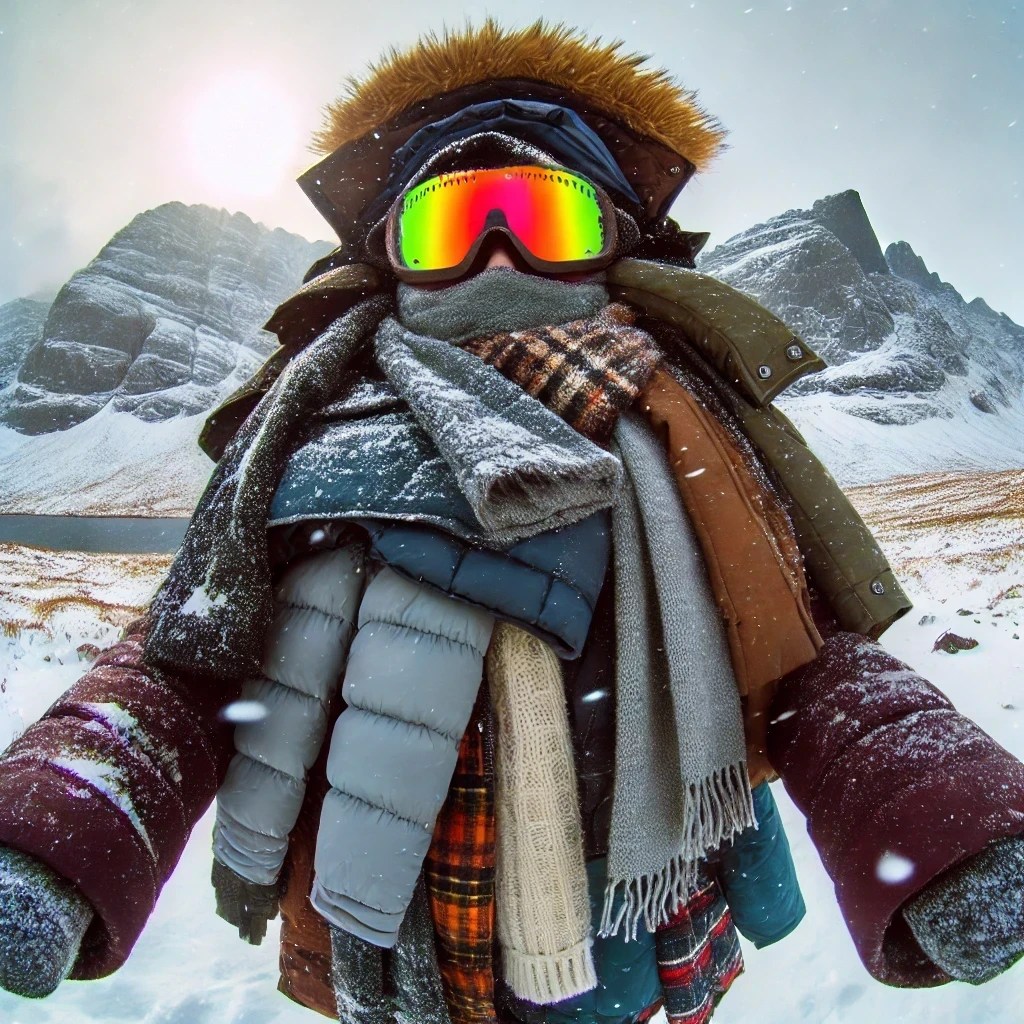
In the Highland mountains we don’t have to worry about suffering from altitude sickness or dealing with air temperatures of -30oC. That doesn’t mean it’s all blue sky and ptarmigan spotting. It’s worth remembering Scottish conditions can be extremely testing at times.
In the early days of the race to summit Everest teams came to train in the Scottish Highlands to test themselves in the harsh, maritime winter climate.
Choosing the right clothing can make a huge difference to how enjoyable a winter day out is. To do that you need to appreciate a few things…
Concepts
Here are the fundamental ideas to understand before you make any clothing choices:
A Note on Style
Clothing style is overrated. The concern for how ones cloths look is a byproduct of human evolution, skillfully exploited by the fashion industry to drive sales and increase profit. Instead of focusing on how a product looks I try to priorities my choice on functionality.
That said, I’ve come to realise that color choice is more important than I initially thought. I used to dismiss colour as merely a fashion tool or marketing tactic.
I’d save money by buying whatever colour was discounted at the end of a season. However, after reading the article below by Dundonnell Mountain Rescue team member Roger Webb, I’ve started to rethink the colours I wear when heading into the hills.
A key message is “Don’t dress like a rock” if you want to get found.
There’s also other great pieces of advice in this article, it’s well worth your time:
https://www.ukclimbing.com/articles/skills/series/rescue/after_the_accident_-_how_to_get_found_alive-15508
Specificity
All of my recommendations are subjective, especially when it comes to clothing. My preferences are tailored to my individual needs and are by no means definitive. For context, I’m male, have relatively short limbs (which may aid in heat retention due to smaller surface area—see Allen’s rule 😦https://en.wikipedia.org/wiki/Allen%27s_rule), carry a healthy amount of body fat, and tend to overheat rather than feel cold when running in winter.
That being said, despite these personal factors, many of my insights will likely apply to you when used in the right context.
Judgment
The ability to choose the right clothing system, decide whether to follow a ridge line or tackle a snow slope, or even know when to stay in bed is key to not just surviving but enjoying winter mountain days.
Unfortunately, when planning at home, we can’t predict the optimal choices with certainty. All we can do is make informed assumptions, adapt as needed, and learn from our mistakes. These informed assumptions come from prior knowledge—gained through education (such as a winter skills course, which accelerates learning in a safer context)—and personal experience on the mountains.
The truth is that good judgment takes years to develop, and even then, it’s never infallible. You can speed up the process through focused learning, feedback loops, self-reflection, immersing yourself in the subject and seeking feedback from others with more experience.
Ultimately, once you have the fundamental skills to keep yourself safe, judgment is something that grows with time and experience. The key is to stay safe, enjoy your time in the hills, and keep going back so you can continue to build that judgment over many adventures.
Challenge
Running presents its own set of challenges, but winter hill running takes it to another level. There’s a temptation to cut corners and fall into the mindset of “don’t overthink it, just make do.” However, I prefer the saying, “Any fool can suffer.”
There are different kinds of suffering in hill running, some of which are necessary—like pushing yourself beyond what you thought possible. But other types of suffering, like painfully cold toes or severe blisters, are avoidable and should be.
These kinds of needless suffering don’t contribute to progress or enjoyment; instead, they can ruin your run and discourage you from coming back.
Science
Clothes are not inherently warm (apart from electrically heated mittens or socks but we can park that for now). Clothing does not provide or create heat. All material does is trap your body heat, help reduce and remove sweat and keep precipitation off your skin.
If your body can no longer produce heat your coat won’t keep you warm. Don’t believe me? Look at all the dead-bodies on Everest wearing very expensive “warm” down suits.
Trapped air that’s been warmed up by our body is what keeps us feeling warm. Achieving this with clothing involves two key strategies:
- Air Trapping Layer: Utilise a mesh or material that creates small air pockets close to the body. These pockets trap heat, thereby reducing heat loss through radiation.
- Protective Outer Layer: Employ a protective layer that shields the warmed air from wind and precipitation. This helps to minimize heat loss through convection and conduction.
By combining these two elements, we can effectively retain warmth and by tweaking the system, we can stay comfortable in cold conditions.
There are countless options and technologies used to achieve a comfortable result.
Sweat management and removal is important in winter because if sweat stays on your body and you slowdown or face a sudden strong wind the sweat will cool your body rapidly.
In warm weather, the solution is simple: wear a vest and shorts, and let the sweat evaporate naturally. Even better, opt for clothes that wick moisture, enhancing the cooling effect. Easy.
Winter adds complexity. Not only do you need to manage heat from running, but you also have to contend with the cold environment. You need layers that allow you to shed excess heat, minimise sweat, and wick moisture—all while protecting against the cold, wet, and wind (and let’s face it, this is Scotland—it’ll likely be wet and windy at some point).
Winter climbers face similar challenges, with long approaches to remote crags and alternating between standing still in the cold and getting hot while climbing. But can we just borrow what they use? Well, not exactly.
Climbers move more slowly, carry more gear, and need heavy-duty equipment. Running requires a different approach—lighter, more mobile, and less bulky gear. We can borrow some principles from climbers, but the specific kit choices differ.
“Cotton kills” is not much of an exaggeration. Some fabrics remove sweat away from the body (a process known as wicking). Synthetic materials typically used in sport or outdoor clothing have this wicking quality. Cotton doesn’t. Cotton clings on to water and will freeze in the winter mountains. Not good. Do not ware anything made of cotton in the mountains.
“You won’t feel the befit” is rubbish. It’s much harder to warm up than it is to maintain warmth. The trick is to adjust layers to keep yourself at a comfortable temperature.
“Be bold, start out cold” is not complete rubbish. As we are running it’s likely we’ll warm up after a few minuets of exercise so it’s wise to start our day a little cold. This way you won’t have to stop 10 minutes into the run to take a layer off.
Clothing Items
By combining various different items of clothing we build up layers which we can add or remove to tune our desired warmth and protection from the elements.
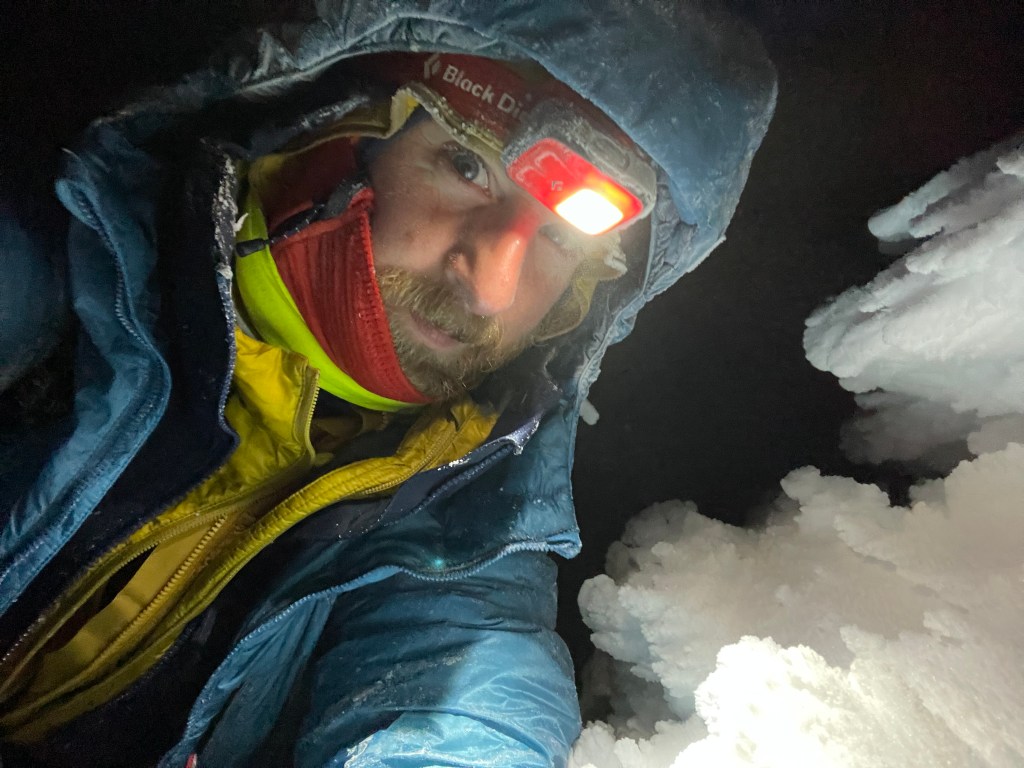
For every piece of clothing, we have to consider its effectiveness and practicality in terms of weight, size, durability, and cost.
Base Layer
This is where I invest the most in my gear, as it’s arguably the most important layer and can be used across many activities beyond running. In winter, I stick to long-sleeve base layers. I’ve found that covering my arms prevents windchill from cooling down exposed limbs, and I never overheat just because my arms are covered.
I opt for long sleeves with a chest zip to help regulate core temperature when needed. I prefer a lightweight blend of synthetic and merino wool, which offers the best of both worlds—warmth without overheating, moisture-wicking, minimal shrinkage, and reduced odour, while remaining reasonably durable.
Thumb loops are great, they help lock in warmth.
Although often overlooked by many, I rate a base layer with hood.
The hood is invaluable for temperature regulation. Hats just don’t cut it for me—I either overheat quickly or find myself constantly taking them off and on, which becomes a hassle. A hood can be pulled up or down instantly, and unlike a hat, it won’t blow away or take up space in a pocket. When you top out onto an exposed ridge and face a cold breeze, a hood offers just enough protection to take the sting out of the wind. If it fits snugly, it moves with your head and blocks out drafts, without needing to be fully windproof—just enough to keep you comfortable. This setup also lets you skip the hassle of using both a buff and a hat.
The base layer that ticked all these boxes for me was the now-discontinued Montane Primino Hybrid Alpine Half Zip Hoodie. While there are other long-sleeve hooded options, few offer a chest zip and the right fabric balance (not too warm). When you get this layer right, you won’t even notice it—it’ll just work. If the wind picks up and you want to preserve your body heat without overheating, you can simply throw on a windproof shell. You’ll stay warm without excessive sweating, even in strong winds.
Unfortunately, not many brands offer a good winter base layer with a snug, well-designed hood and venting options. You may need to shop around.
I’m always on the lookout for a thin winter base layer with thumb loops, a hood and chest venting zip. If you know of one let me know!
Mid layer Insulation
This is where things get more subjective, with plenty of room for personal adjustments. In Scotland, insulation will inevitably get damp—either from sweat or rain—so down isn’t ideal, as it loses effectiveness when wet. Synthetic insulation is the way to go. Your choice will depend on whether you typically run hot or cold, the weather forecast, how remote your route is, and how long you’ll be out.
In the past, I’ve usually carried a medium-weight synthetic jacket, like the Patagonia Nano-Air, along with either an extra base layer or a heavier layer (sometimes a Paramo jacket). However, for the last couple of winters, I’ve switched to using a synthetic gilet (vest) paired with a full-on synthetic belay jacket as a backup.
Here’s my reasoning: I’m likely to put on the gilet sooner than I would a full medium-weight jacket. A gilet doesn’t cause as much sweat buildup but still does enough to keep my core warm, which is crucial for maintaining warmth throughout the rest of the body.
The belay jacket, typically worn by climbers when standing still for extended periods, is my emergency layer for when it gets seriously cold. I use the Patagonia DAS Parka Light, which is fairly simple in design but generously cut to fit over all my layers, and it’s great at trapping heat. It’s worth its weight, and having it in my pack gives me peace of mind, allowing me to enjoy my day more.
Recently, I tracked down a synthetic gilet with a hood. My thinking is that if I can’t replace my prized base layer (it’s becoming more holes than fabric, and Montane has no plans to make more), I can switch to a hoodless base layer and rely on the gilet’s hood.
Synthetic gilets aren’t widely used by hill runners and I’m not sure why. Perhaps people don’t know how to layer with them or understand the benefit? Anyway, I think gilets are a great option for winter mountain running.
Basically I’m able to wear a gilet more often than a full jacket since it’s less prone to causing overheating.
Leg Coverage
Shorts
The coolest look of all time is crampons and shorts. Pure fashion.
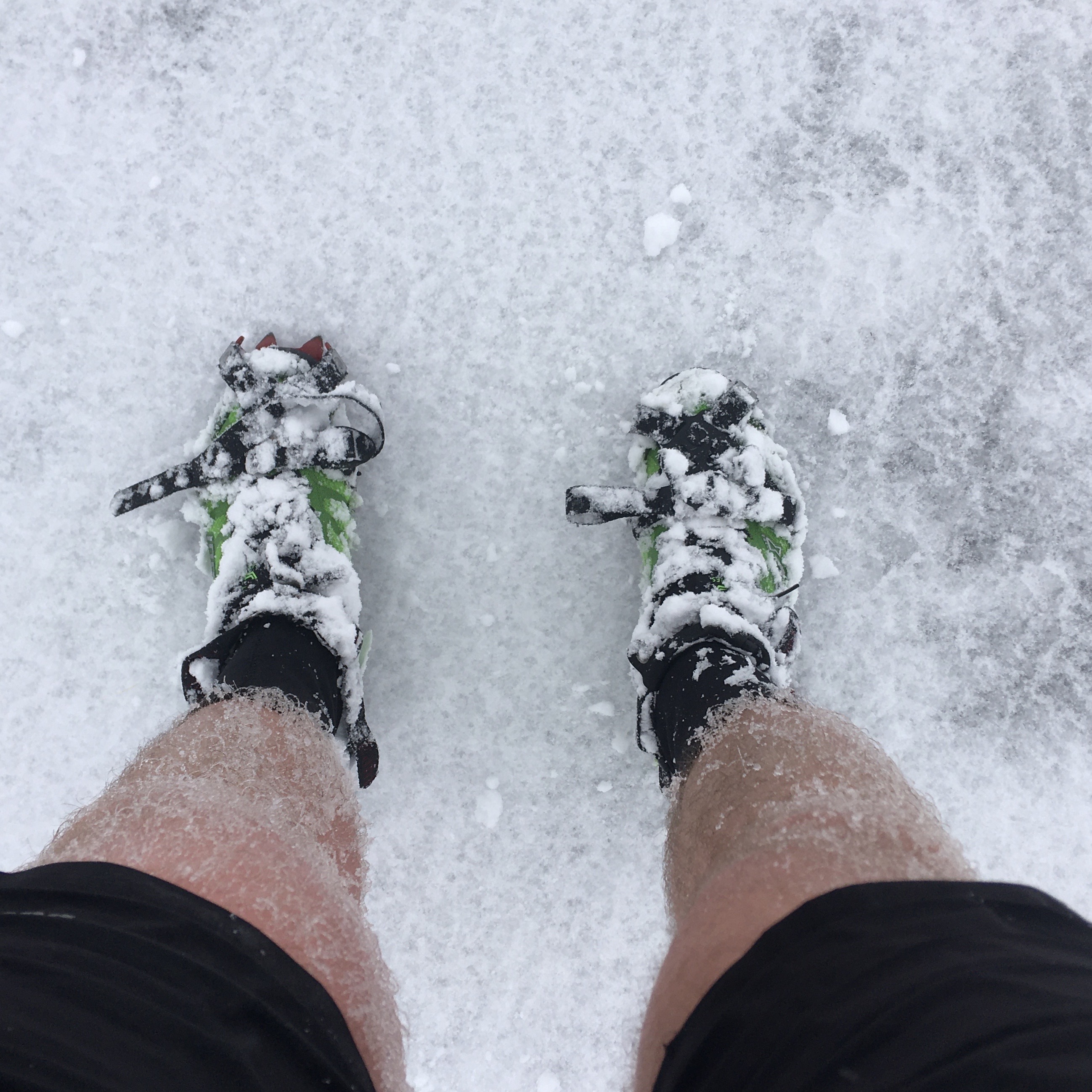
Unfortunately the uncoolest look of all time is red socks soaked in blood gushing from ankles and shins. This embarrassing catwalk getup results from skin meeting an icy crust sat on the top surface of snow. I know friends who have had scaring and burns (yes you can get cold burns) from having exposed legs meet unfriendly snow.
That doesn’t mean you shouldn’t ever ware shorts in snow, you just need to really understand conditions and carry a layer to change into in case you get it wrong. Another option is to wear high socks (admittedly less cool, depending on your personal outlook on such items) which will help protect your shins a bit.
Running Tights/leggings
Standard running tights will be fine. However if you’re wanting optimal there are a few specific winter mountain tights being made now. They have extra insulation properties and some have windproof paneling in areas where you don’t want a stiff breeze. I like the Inov8 Winter Tights I own.
Waterproofs
Waterproof Coat
This layer is crucial for keeping out wind and wet, especially in the UK, where it’s likely to see heavy use and be pushed to its limits.
A high-quality hardshell with a good waterproof rating (measured in hydrostatic head, or HH) and excellent breathability (MVTR, standing for moisture vapor transmission rate) is a solid starting point. However, don’t rely solely on the stats—features, cut, and personal fit can make a significant difference.
In the past, I used the Inov8 Stormshell and was happy with it. The cut was a bit loose and flappy, but it held up well over time and was reasonably priced.
Eventually the Stormshell wore out and I upgraded to the Arc’teryx Norvan LT Hoody. The fabric is outstanding, and the cut is much better. That said, there are a couple of features I miss—mainly thumb loops—and the hood adjustment toggle is too small and doesn’t cinch the hood down as much as I’d like. Still, the Gore-Tex fabric performs impressively, keeping me dry and proving to be durable.
Waterproof Trousers
There are some extremely lightweight waterproof trousers that don’t make that awful flapping noise in the wind. These are great for most of the year and work well on winter days when the forecast is favorable.
However, they’re not particularly durable. For harsher conditions, a medium-weight pair designed for climbing or hiking may be a better choice.
If you’re like me, you probably avoid wearing waterproof trousers while running unless it’s absolutely necessary. So when you finally do put them on, the weather is likely pretty grim. In those moments, you’ll be glad you opted for a more robust, durable pair instead of the featherweight racing version.
Emergency Insulation
One fairly concrete rule for winter mountain running is always carry an emergency layer or two.
This is an emergency layer so I wouldn’t plan on running in my jacket. It doesn’t need to breath well or fit under my waterproof. I carry it so that if I was forced to stop for hours I’d survive the cold.
Your emergency insulation could literally save your life.
There are lots of great light, effective synthetic belay jacket options available. I take either a Patagonia DAS Light Hoody or a Rab Generator Alpine Jacket depending on the forecast.
More on emergency kit here.
Other bits
Underwear
I use synthetic rather than merino wool. I don’t use anything particularly fancy or different from summer options. NOT COTTON.
Gloves
I like having a light, thin pair that I’ll use when running up to the snow line and then change into some thicker, waterproof/resistant gloved for when I’m in the snow.
I also carry a pair of warm emergency mittens. I like the Montane Extreme Mitt, it’s a fleece lined, windproof mitten and light. Although there are many good options available.
Buff
Neck tubes are a versatile bit of kit, worth carrying a light weight merino one. I keep my goggles wrapped inside one, stashed in a dry bag.
Socks & Shoes
Footwear is a whole article in itself: Footwear for Winter Mountain Running
Emergency kit
Emergency kit is a whole article in itself: Emergency Kit for Winter Mountain Running
What about Goggles, bag, helmet, poles, food and water?
All that in another article coming soon.

Winter Skills Course for Runners
Learn from a qualified Winter Mountain Leader how to look after yourself in real winter conditions.
The Winter Skills Course for Runners is designed to help you become a capable, independent and responsible winter mountain runner.
The two day course based out of Dingwall focuses on developing knowledge and skills needed for winter mountain runs.
To maximise in person, hill side learning on a course please read the articles. They will help you on your journey to independent winter mountain adventures.
If you have any questions please send me a message.
Sourcing Kit
Personal circumstances will dictate what gear you can afford and how you source your kit.
Consider borrowing, experimenting with items you already own and shopping second hand before taking the plug and buying new.
If buying new it’s worth taking a moment and consider companies ethical policies, of particular interest is their impact on the environment and climate change (no point in having a great snow jacket if there’s no snow left).
Skimo racers face many of the same challenges as winter hill runners, so looking to companies that make gear for that sport might be a smart move—though good luck getting your hands on it in post-Brexit UK.
The coolest and optimal choice would be to make or adapt your own clothing.
Key takeaways
- Clothes aren’t inherently warm, they capture your body’s heat.
- Don’t wear cotton.
- Don’t dress like a rock.
- Carry full waterproof coverage.
- Pack spare gloves & buff.
- Take an emergency insulation layer.
- Experiment with different clothing combinations.
- A synthetic belay jacket is worth the weight penalty.
 WinterSkills.Scot